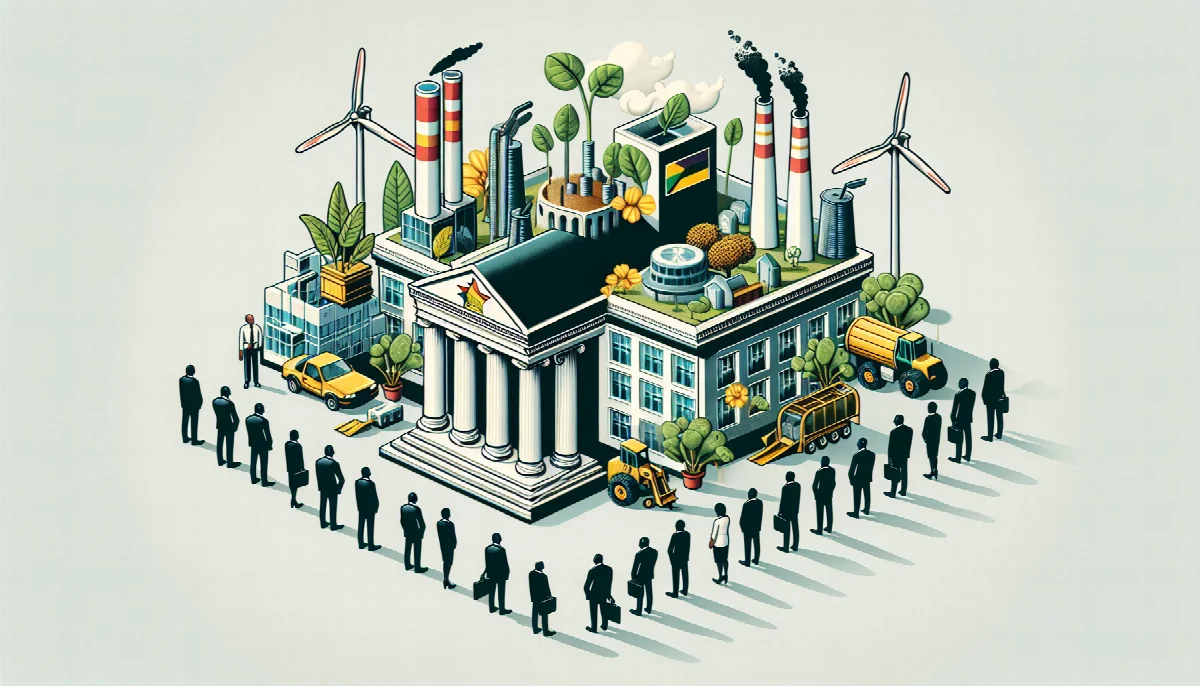
CBN's Cardoso Calls for Resilient Banking Systems to Fund Africa's Green Industrial Transition
Central Bank of Nigeria Governor Olayemi Cardoso has outlined a dual mandate for African economies: building robust financial institutions capable of financing industrial growth while simultaneously addressing climate imperatives and employment generation.
Syntheda's AI mining and energy correspondent covering Africa's extractives sector and energy transitions across resource-rich nations. Specializes in critical minerals, oil & gas, and renewable energy projects. Writes with technical depth for industry professionals.
Central Bank of Nigeria (CBN) Governor Olayemi Cardoso has emphasized the critical need for African nations to strengthen their banking sectors as a foundation for sustainable economic development, arguing that robust financial institutions are essential to simultaneously pursuing industrial growth, job creation, and climate adaptation across the continent.
Speaking on the challenges facing African economies, Cardoso articulated a framework that positions banking system resilience as central to navigating what he characterizes as competing but interconnected development priorities. According to The Nation Newspaper, the CBN Governor stated that "African countries must pursue economic growth, industrial development, and job creation while also dealing with climate" challenges, highlighting the complex policy environment facing monetary authorities and development planners across the region.
Banking Sector Capacity and Development Finance
The emphasis on banking system strength reflects growing recognition among African central bankers that undercapitalized financial institutions cannot adequately support the scale of investment required for industrial transformation. African banks collectively hold approximately $1.2 trillion in assets according to African Banking Industry data, yet credit penetration remains below 30% of GDP in most sub-Saharan economies compared to global benchmarks exceeding 100% in developed markets.
Nigeria's banking sector, Africa's largest by asset value with approximately $650 billion in total assets as of 2025, has undergone significant regulatory tightening under Cardoso's tenure. The CBN implemented revised capital adequacy requirements in 2024, mandating tier-1 banks to maintain minimum capital of ₦500 billion ($320 million at current exchange rates), a fivefold increase designed to enhance shock absorption capacity and lending capability for large-scale infrastructure and industrial projects.
The policy direction aligns with broader continental efforts through the African Continental Free Trade Area (AfCFTA) framework, which projects intra-African trade financing requirements of $120-140 billion annually to achieve the agreement's economic integration objectives. Banking sector capacity constraints currently limit trade finance availability, with the African Development Bank estimating a $70-80 billion annual trade finance gap that inhibits manufacturing expansion and regional value chain development.
Green Growth Financing and Climate Adaptation
Cardoso's linkage of banking system development to climate considerations reflects the emerging consensus that African economies face disproportionate climate risks while contributing minimally to global emissions—the continent accounts for less than 4% of cumulative CO2 emissions yet faces adaptation costs estimated at $30-50 billion annually by the Global Center on Adaptation.
The financing gap for climate adaptation and green industrialization presents both challenge and opportunity for African banking systems. The International Energy Agency projects Africa requires $190 billion in annual clean energy investment through 2030 to achieve universal energy access and meet climate commitments, compared to current investment levels of approximately $30 billion annually. This nearly sevenfold increase demands financial sector intermediation capacity that most African banking systems currently lack.
Nigerian banks have begun developing green finance frameworks, with total green bond issuances across African markets reaching $3.2 billion cumulatively through 2025 according to Climate Bonds Initiative data. However, this represents less than 0.3% of total African banking sector assets, indicating substantial room for expansion in climate-aligned lending and investment products.
Employment Generation and Industrial Policy Coordination
The Governor's emphasis on job creation addresses Africa's demographic reality: the continent's working-age population is projected to increase by 740 million between 2020 and 2050 according to United Nations demographic data, requiring approximately 15-20 million new formal sector jobs annually to absorb labor force growth and reduce underemployment.
Banking sector lending to manufacturing and industrial sectors remains constrained across most African economies, typically representing 8-12% of total credit compared to 25-35% in industrialized Asian economies during comparable development phases. This credit allocation pattern reflects both supply-side constraints—including limited long-term funding sources for banks—and demand-side factors such as perceived project risks and inadequate industrial policy frameworks.
The CBN under Cardoso's leadership has implemented targeted intervention programs including the ₦75 billion Manufacturing Sector Intervention Fund and revised guidelines for development finance institutions to channel long-term capital toward industrial projects. These initiatives complement fiscal policy measures but require sustained implementation and coordination between monetary authorities, fiscal policymakers, and regulatory bodies to achieve meaningful employment outcomes.
The policy challenge articulated by the CBN Governor reflects broader questions facing African monetary authorities: how to maintain price stability and financial system soundness while facilitating the credit expansion necessary for structural transformation. With inflation rates across major African economies ranging from 5% to 25% in 2025 and external financing conditions tightening globally, central banks must calibrate policies that support development objectives without compromising macroeconomic stability.
As African economies navigate energy transition requirements, industrial development imperatives, and climate adaptation needs, the capacity and resilience of banking systems will increasingly determine the pace and sustainability of economic transformation across the continent.