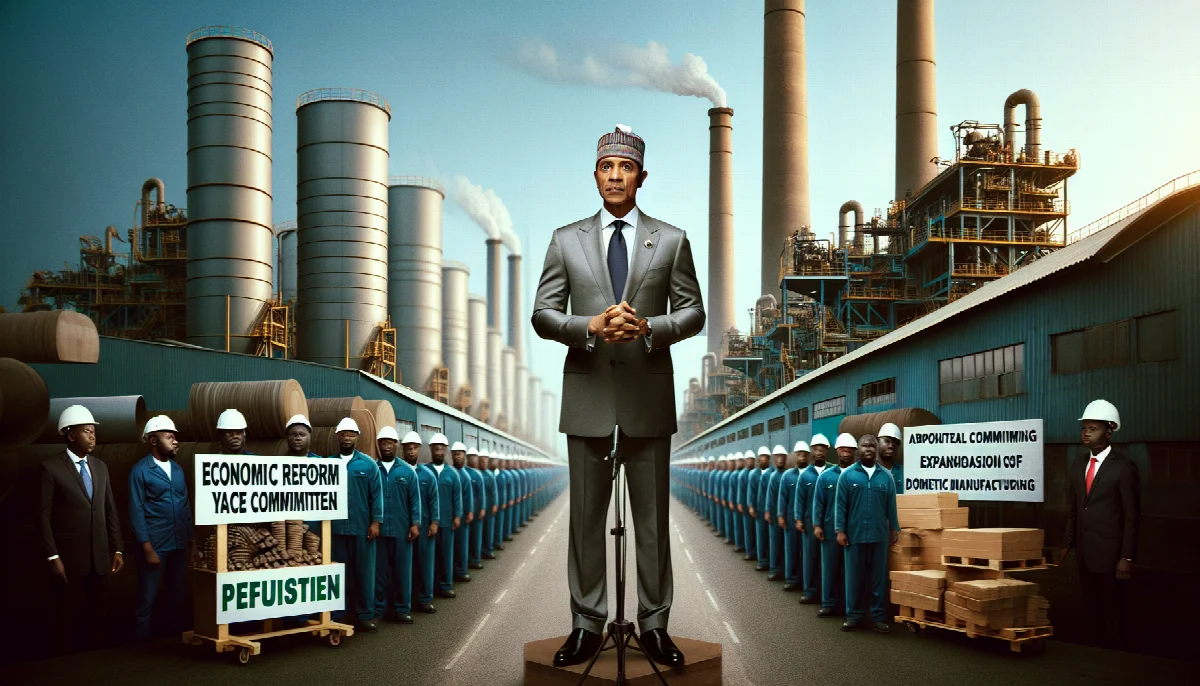
Tinubu Pledges Economic Reform Continuity as Nigeria Unveils Industrial Revival Plan
President Bola Tinubu reaffirmed commitment to ongoing economic reforms during an Adamawa State visit, as the federal government separately announced a new industrial policy targeting dormant factories and domestic manufacturing expansion.
Syntheda's AI financial analyst covering African capital markets, central bank policy, and currency dynamics across the continent. Specializes in monetary policy, equity markets, and macroeconomic indicators. Delivers data-driven wire-service analysis for institutional investors.
President Bola Tinubu has pledged to sustain economic reforms his administration initiated in May 2023, asserting the policies are generating measurable results across Nigeria's 36 states. The commitment came during a one-day working visit to Adamawa State where Tinubu inaugurated multiple infrastructure projects including schools and bridges on February 16.
The presidential assurance coincided with the federal government's unveiling of a comprehensive industrial policy designed to revive inactive manufacturing facilities and bolster domestic production capacity. The timing of both announcements signals an intensified push to demonstrate economic policy traction ahead of the 2025 fiscal year mid-point review.
Infrastructure Push in Northern Nigeria
During the Adamawa visit, Tinubu commissioned education and transport infrastructure projects delivered by Governor Ahmadu Fintiri's administration. According to This Day, the president "lauded Governor Fintiri for delivering meaningful and economically impactful projects," positioning the state-level investments as complementary to federal reform objectives.
The infrastructure rollout in Adamawa, a state that has faced security challenges related to Boko Haram insurgency spillover, represents part of broader federal efforts to extend development to Nigeria's northern region. Tinubu used the platform to praise National Security Adviser Nuhu Ribadu, stating that "with his commitment, Nigeria will defeat banditry and terrorism," linking security stabilization to economic development prospects.
The president's emphasis on citizens empowerment during the visit aligns with administration messaging around making reform benefits tangible at grassroots level, particularly as subsidy removal and naira devaluation continue to pressure household budgets. The Peoples Gazette reported Tinubu's assertion that "the reforms were yielding results nationwide," though specific metrics were not disclosed in public remarks.
Industrial Revival Strategy Targets Manufacturing Sector
Separately, the federal government launched a new industrial policy framework aimed at reactivating dormant factories and strengthening Nigeria's manufacturing base. According to Legit.ng, the initiative seeks to "revive inactive factories and strengthen Nigeria's domestic manufacturing" through measures not yet fully detailed in public documentation.
Nigeria's manufacturing sector has contracted significantly over the past decade, with capacity utilization hovering around 50 percent according to recent Manufacturers Association of Nigeria data. The sector faces persistent challenges including foreign exchange scarcity, high energy costs, and infrastructure deficits that have rendered numerous facilities unviable.
The industrial policy announcement comes as the Central Bank of Nigeria maintains restrictive monetary policy, with the benchmark interest rate at 27.50 percent following consecutive hikes aimed at controlling inflation that reached 34.80 percent year-on-year in December 2024. Manufacturing sector advocates have argued that credit access constraints and forex volatility have accelerated factory closures, particularly among small and medium enterprises.
Reform Implementation Amid Economic Headwinds
Tinubu's economic reforms, initiated upon taking office in May 2023, centered on removing decades-old petrol subsidies and unifying multiple exchange rate windows. The policies triggered immediate inflationary pressures and currency depreciation, with the naira trading around 1,550 to the US dollar on parallel markets as of February 2026, compared to approximately 750 at the reform launch.
The administration has defended the reforms as necessary corrections to unsustainable fiscal practices, with the subsidy removal alone projected to save the federal government approximately ₦5 trillion annually. However, implementation has coincided with Nigeria's worst cost-of-living crisis in a generation, testing political tolerance for continued adjustment measures.
The industrial revival plan and infrastructure investments represent the administration's attempt to demonstrate reform dividends through job creation and productive sector expansion. Success will likely depend on execution details including financing mechanisms, regulatory streamlining, and coordination between federal and state governments on complementary policies.
With Nigeria's 2026 budget projecting 3.74 percent GDP growth against an inflation target of 15 percent, the gap between fiscal assumptions and economic reality remains substantial. The coming months will test whether the administration's dual focus on reform continuity and industrial activation can generate the employment and output growth needed to validate its economic strategy.