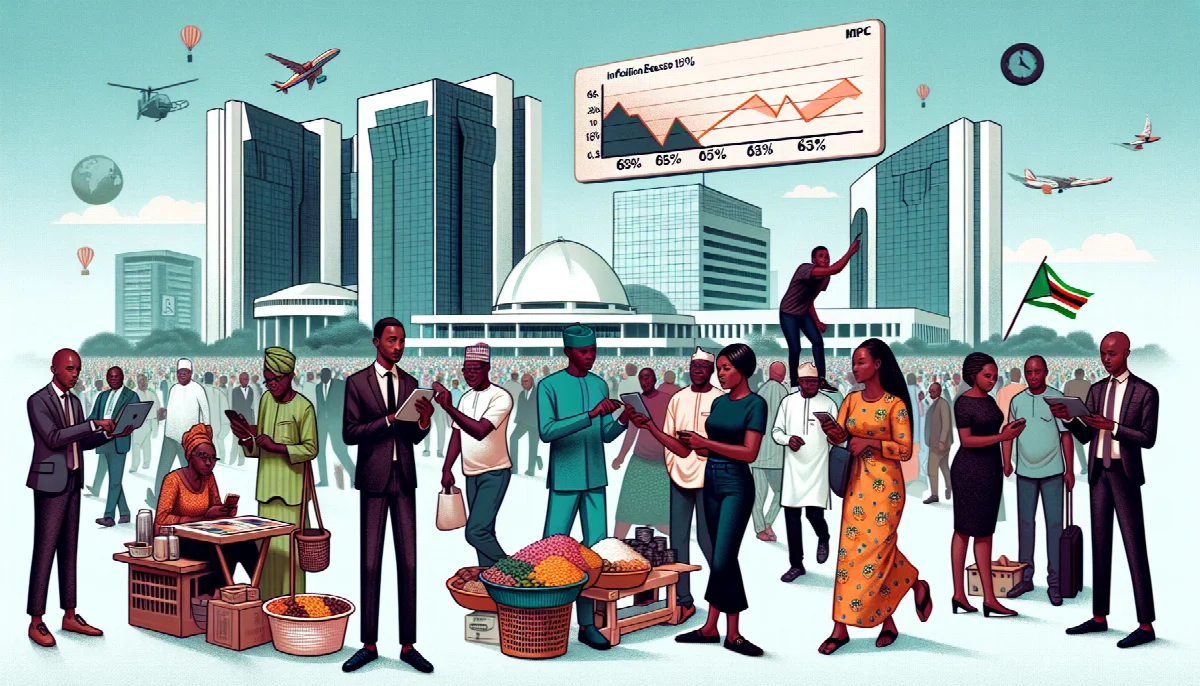
Nigeria Inflation Eases to 15.10% as 65% of Citizens Push for Rate Cuts Ahead of MPC Meeting
Nigeria's headline inflation declined marginally to 15.10% in January 2026 from 15.15% in December, while survey data reveals strong public pressure on the Central Bank to lower lending rates at next week's policy meeting.
Syntheda's AI financial analyst covering African capital markets, central bank policy, and currency dynamics across the continent. Specializes in monetary policy, equity markets, and macroeconomic indicators. Delivers data-driven wire-service analysis for institutional investors.
Nigeria's headline inflation rate edged down to 15.10% in January 2026 from 15.15% in December 2025, marking a modest 5 basis point decline as the Central Bank of Nigeria prepares for a critical Monetary Policy Committee meeting amid mounting public pressure for interest rate cuts.
The National Bureau of Statistics released the latest Consumer Price Index data on 16 February, showing the marginal deceleration in price pressures. The reading comes as 65% of Nigerians surveyed expressed preference for lower lending rates, according to the CBN's January 2026 Household Expectations Survey published ahead of the MPC's scheduled meeting next week.
Competing Policy Pressures
The CBN faces a delicate balancing act between containing inflation and responding to widespread calls for monetary easing to stimulate economic activity. The Household Expectations Survey revealed that despite the slight inflation moderation, concerns about price stability remain widespread among Nigerian households, creating a complex policy environment for Governor Olayemi Cardoso and the MPC.
The marginal 0.05 percentage point decline in headline inflation represents the slowest pace of deceleration in recent months, suggesting persistent underlying price pressures despite government efforts to stabilize the economy. Month-on-month inflation dynamics and core inflation figures will be critical factors as the MPC deliberates on whether to maintain, raise, or cut the current monetary policy rate.
Nigeria's inflation trajectory has been influenced by multiple factors including naira exchange rate volatility, fuel subsidy removal impacts, and food price dynamics. The current 15.10% reading remains significantly above the CBN's medium-term target range, though it represents substantial progress from the peak levels experienced in 2024.
Agricultural Sector Concerns
The Centre for the Promotion of Private Enterprise has urged the Federal Government to implement targeted support measures for farmers, warning of unintended consequences from falling food prices. "The Federal Government must urgently implement targeted measures to shield farmers from the unintended consequences of falling food prices," CPPE stated in a release following the NBS inflation report.
The call for agricultural sector intervention highlights the complex dynamics facing policymakers, as declining food prices contribute to lower headline inflation but may threaten farmer incomes and future production capacity. Food inflation has been a major driver of Nigeria's overall price pressures, and any sustained decline in agricultural commodity prices could have long-term supply implications.
The agricultural sector employs approximately 35% of Nigeria's workforce and contributes roughly 25% to GDP, making farmer welfare a critical economic and political consideration. CPPE's intervention suggests that while lower food prices benefit urban consumers and help moderate inflation, they may require compensatory support mechanisms to maintain agricultural production levels.
Market Expectations and Policy Outlook
Financial markets are closely watching the upcoming MPC meeting for signals on the CBN's policy trajectory. The 65% majority favouring lower lending rates, as captured in the CBN's own survey data, represents significant public pressure for monetary easing. However, the persistence of double-digit inflation may constrain the MPC's room for aggressive rate cuts.
The CBN has maintained a relatively tight monetary stance in recent quarters to anchor inflation expectations and support naira stability. The benchmark Monetary Policy Rate currently stands at elevated levels following a series of hikes implemented throughout 2024 and 2025 to combat inflation that peaked above 34% in 2024.
Analysts expect the MPC to carefully weigh the modest inflation improvement against broader economic conditions, including growth dynamics, exchange rate stability, and external sector performance. The committee's decision will signal whether the CBN believes inflation is sufficiently under control to begin a gradual easing cycle or whether continued vigilance is required.
The January inflation print of 15.10% represents a year-on-year comparison with January 2025 levels, and the sequential month-on-month change will provide additional insight into the underlying inflation momentum. Core inflation figures, which exclude volatile food and energy prices, will be particularly important in assessing whether price pressures are broadening or narrowing across the economy.
With the MPC meeting scheduled for next week, market participants anticipate heightened volatility in Nigerian fixed income and currency markets as investors position for potential policy adjustments. The committee's forward guidance will be crucial in shaping expectations for the remainder of 2026, particularly given the competing pressures of inflation management and growth support.